Trust and Transparency: Understanding the U.S. Hemp Authorityยฎ Certification Program

This week our post is brought to you by Dr. Marielle Weintraub, President of the U.S. Hemp Authorityยฎ and Director of Scientific Research and Development at Zilis, and joining her is nationally known hemp expert and attorney, Jonathan Miller. Together Dr. Weintraub and Mr. Miller offer insight into this award-winning hemp certification program and why earning this prestigious seal of approval is so important for building trust and transparency in the hemp industry.

A main challenge facing reputable, quality-focused, and consumer-safety conscious hemp companies today are all the companies who are poorly manufacturing CBD products and selling them with misleading labels and making illegal disease claims.  Unfortunately, the good and the not-so-good hemp companies all get lumped together, and it can be very hard for consumers to understand which products they should be investing in.

Now more than ever, consumers are paying attention to the ingredients that they are putting into their bodies. They are looking for ways to help support their overall wellness and by actively seeking information to understand as much as they can. Truth-in-labeling and transparency of products remains the number one consumer necessity, especially when it comes to hemp and CBD products, but additionally for all dietary supplements they plan on purchasing. Due to state regulations and, in some cases, a choice, hemp CBD companies are much more transparent than many mainstream dietary supplement companies. As an example, hemp industry companies have an increasing trend of posting Certificates of Analyses (COA) clearly online or using QR codes (as per state regulations) on their products to disseminate COA information. This transparency is helping consumers identify legitimate products.
Recently aย reportย was released by the U.S. Food and Drug Administration in response to the Congressional Directive regarding Cannabidiol toย โ€œโ€ฆperform a sampling study of the current CBD marketplace to determine the extent to which products are mislabeled or adulterated and report to the Committees within 180 days of enactment of this Act.โ€ย Following testing of various types of CBD-infused products, the FDA found that many were mislabeled, containing far less or far more CBD than listed on the product label. Interestingly, although there were a high number of mislabeled products regarding their cannabinoid content, the majority of products tested did not contain contaminant levels, such as heavy metals, considered to be unsafe. This was a point of concern previously voiced by the FDA as hemp is a well-known phytoremediator.

Phytoremediation is a process where living plants essentially clean the soil, air, and water that may be contaminated (with undesirable heavy metals, pesticides, or other toxins). This is great for the earth, but because they are absorbedย into the plant, can be harmful if ingested.
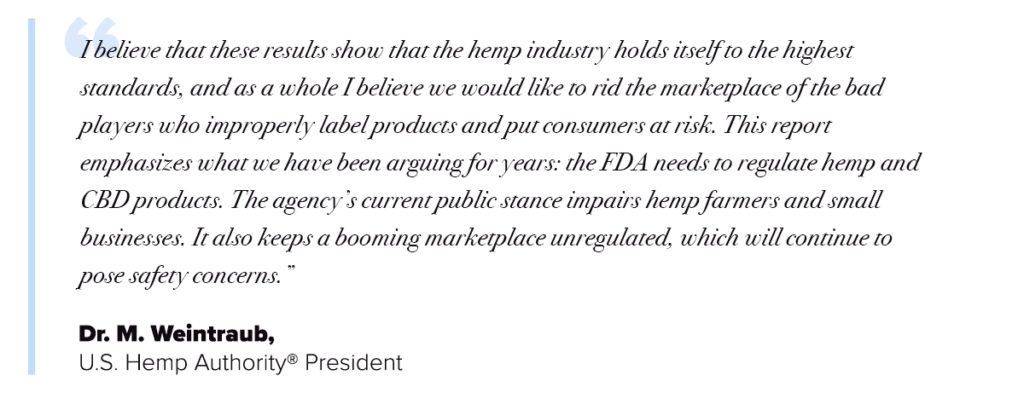
Because of the continued lack of regulation from FDA, the U.S. Hemp Authorityยฎย (USHA) developed a robust program to build trust in hemp and CBD products. By certifying hemp growers, manufacturers, processors, and brand owners, through third-party independent audits, USHA has returned confidence to where it was missing, and trust to where it was needed.
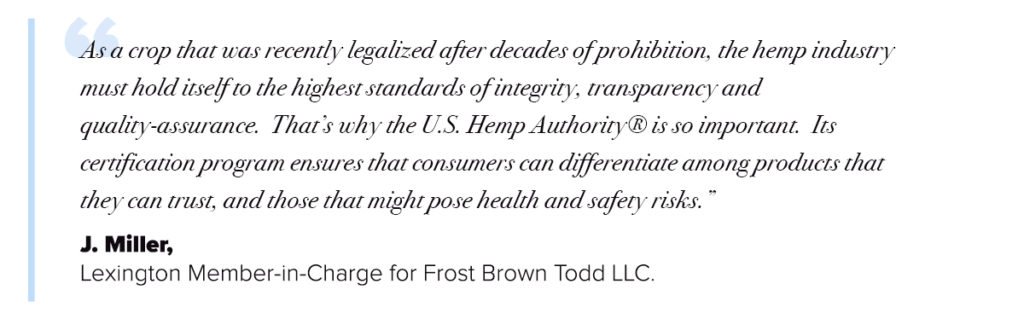
To better understand the U.S. Hemp Authorityยฎย it must be first recognized that USHA is a non-profit trade association that is dedicated to improving business conditions within the emerging hemp industries to establish high standards, best practices, and self-regulation that enable commerce and consumers to identify consumable hemp products they can trust. USHA is not a member-driven organization and does not collect dues of any kind; you canโ€™t just โ€œjoinโ€ USHA. This isย notย a pay-to-participate organization. Like other certification agencies, those who seek certification must pay a fee to a third-party auditing agency to conduct an independent on-site audit and meet or exceed the requirements entailed in USHA guidance document. Obtaining third-party independent certification requires rigorous commitment to excellence, a physical audit inspection that includes label validation, COA inspections, manufacturing information, auditor interaction with employees, and a willingness to have auditors comb through a companyโ€™s processes and procedures, and much more. In addition, for a product to earn the USHA Seal, not only must the product qualify through the audit, the products must be derived from hemp plants. Cannabinoids from genetically modified and bio-engineered hemp are not permitted in the USHA program.
The rigorous audit is conducted by the third-party independent auditing agency FoodChain ID,  a well-respected, BRCGS Five-Star Rated agency, who conducts USDA Organic Certifications as well as certify for the non-GMO Project Butterfly organization. Certification fees that allow a USHA Certified Company to use the USHA Seal are paid directly to FoodChain ID, with a fraction of that fee being distributed to the USHA for its operating budget.

USHA was purposefully formed and developed by stakeholders in the hemp industry to be a certification program that would fit the specific needs of the hemp industry.  Therefore, the USHA trade association was set up to have both a Board of Directors and Technical Committee made up of members who serve on a volunteer basis and receive no compensation. USHA is governed through bylaws and additional governing documents that mandate a scrupulous conflicts of interest policy, including the requirement for all board and committee members to understand their obligations under these policies and to execute and submit the comprehensive โ€œDeclaration of Conflicts of Interestโ€ form annually and at any time there is a change in an actual or perceived conflict of interest.

Companies that choose to undergo this rigorous third-party audit do so in hopes that their products can carry the prestigious U.S. Hemp Authorityยฎ Certification Seal.  Zilis proudly earned the USHA Certification Seal in 2019, and as the Certification has a yearly audit mandatory for renewal, the Zilis quality team is prepared for the 2020 audit. UltraCellยฎ products proudly carry the U.S. Hemp Authority Seal on every bottle.   The USHA Seal gives consumers piece of mind and an easy way to identify that they are getting the most trusted products available in the hemp market.
State Regulatory Overview & Federal Factors

Our post this week is brought to you by guest blogger Joy Beckerman, an expert in hemp law and regulations and the new Director of Regulatory and Legal Affairs at Zilis. Joyโ€™s overview of the different Statesโ€™ regulatory guidelines and contributing Federal factors helps shed light upon how the industry is moving forward and what the industry leaders are doing to ensure access across the country.The dome of the United States capitol with an American flag and dramatic clouds behind

As a preliminary matter, itโ€™s key to understand that just because a Federal law is passed to either partially or fully legalize something, it doesnโ€™t mean that it automatically becomes legal in all 50 States. Under the U.S. Constitution, each of our 50 states wield and maintain political powers held for its own State government rather than Federal government. This is why we see a patchwork of laws and their corresponding regulations across the 50 States on a spectrum of issues.

2014 Farm Bill

After decades of advocacy by dedicated grassroots activists and heroic professionals and legislators who later joined the hemp revolution, a short but significant provision titled, โ€œLegitimacy of Industrial Hemp Researchโ€ within the Agricultural Act of 2014 (2014 Farm Bill) was passed; and the amazing hemp crop began to re-establish itself under agricultural pilot programs to study the growth, cultivation, and marketing of industrial hemp in States that enacted laws allowing the cultivation of hemp. The 2014 Farm Bill also defined industrial hemp for the first time in U.S. history, thereby distinguishing it from its Cannabis cousin commonly known as marijuana.

While the 2014 Farm Billโ€™s introductory words clearly stated, โ€œIn Generalโ€“notwithstanding the Controlled Substances Actโ€ฆโ€ 1 โ€”meaning not subject to the Controlled Substances Actโ€”the U.S. Drug Enforcement Administration (DEA) held and publicized the erroneous position for the next four years that hemp extract and cannabinoids derived from hemp were still controlled substances.

The hemp industry was ultimately forced to file a lawsuit against the DEA in the Ninth Circuit Court of Appeals to prove that no part of the hemp plant sown under the provisions of the 2014 Farm Bill, including hempโ€™s derivatives, extracts, and cannabinoids, were controlled substances. Yet, due to the DEAโ€™s messaging, many States were hesitant to embrace the safe and legal opportunities provided by the agricultural pilot program pathway.

2018 Farm Bill

Learning from all this confusion, hemp industry advocacy organizations and Federal legislators began to carefully and strategically draft expanded hemp provisions in the Agriculture Improvement Act of 2018 (2018 Farm Bill), which was enacted on January 1, 2019. The three most relevant provisions of what weโ€™re seeing among the 50 Statesโ€™ permissions and regulationโ€”or lack thereof, as the case may beโ€”are as follows:2

  • Hemp and tetrahydrocannabinols derived from hemp were unequivocally removed from the Controlled Substances Act;
  • The definition of โ€œhempโ€ was expanded for total clarity by specifically stating, โ€œThe term โ€˜hempโ€™ means the plant Cannabis sativa and any part of that plant, including the seeds thereof and all derivatives, extracts, cannabinoids, isomers, acids, salts, and salts of isomers, whether growing or not, with a delta-9 tetrahydrocannabinol concentration of not more than 0.3 percent on a dry weight basis.โ€ (Emphasis added.); and
  • Nothing in the Bill affects or modifies the Federal Food, Drug, and Cosmetic Act.
Image source Florida Farm Bureau.

The final point about the Federal Food, Drug and Cosmetic Act is important for the hemp industry with regard to dietary supplements and food additives. Within the Federal Food, Drug, and Cosmetic Act, a provision commonly referred to as the โ€œInvestigational New Drug (IND) Preclusion,โ€ states that if an article has been authorized for investigation for which substantial clinical investigations have been instituted, and made public, then products containing that substance are precluded from the definition of a โ€œdietary supplementโ€ unless it was marketed as a dietary supplement or as a conventional food before new drug investigations were authorized.3

What does this mean? A great example is the use of cannabidiol (CBD) in the approved drug EPIDIOLEXยฎ. Cannabidiol was submitted as an IND, with substantial clinical investigations made public, and it is currently being debated as to whether CBD can be considered a dietary supplement because no evidence has thus far been identified to demonstrate that CBD  was marketed as a dietary supplement before being used in clinical trials to treat specific childhood epilepsy disorders. Regardless of such evidence, this same statute also grants authority to the U.S. Food & Drug Administration (FDA) to override this restriction and simply issue a regulation allowing a substance to be marketed as a dietary supplement that would otherwise be prohibited under the IND Preclusion. The IND Preclusion only applies to dietary supplements and foods and does not apply to cosmetics, thus cosmetics containing CBD are not affected.

The Market

Despite the ongoing debate, the CBD dietary supplement and food markets have grown to such an extent that the Gallup Poll reported in August of 2019 that one in seven [or 14% of] Americans is using a CBD product of some kind.4 This has occurred because the FDAโ€™s statements concerning the debate amount only to a guidance position at this point. The FDAโ€™s guidance position has never been determined by the courts to be valid, and is neither final, nor legally binding since no final agency actions or determinations have been issued on the subject. In fact, FDA Commissioner Stephen Hahn recently stated during his address at the National Association of State Departments of Agricultureโ€™s 2020 Winter Policy Conference, โ€œPeople are using these [CBD] products. Weโ€™re not going to be able to say, โ€˜You canโ€™t use these products,โ€™ becauseโ€ฆeven if you did, itโ€™s a foolโ€™s game to even try to approach that.โ€5

The hemp industry coalition has been lobbying the FDA to use its overriding authority to allow CBD products to be marketed as dietary supplements and added to food. It has also been providing guidance and safety data to assist the FDA in creating a regulatory framework for quality assurance oversight of hemp processing. The coalition has also been lobbying Congress to mandate these actions, and there is much encouraging movement in these regards.

Challenges Today

In the meantime, and until the FDA formally acts, a mishmash of State laws and regulations govern CBD, with some States only allowing cosmetic CBD products to be sold, and others still not allowing any CBD products to be sold. Conversely, certain States allow all CBD products to be sold with virtually no oversight, while yet others are taking quality assurance into their own hands by creating laws and regulations allowing the sale of all or certain CBD products that are produced in accordance with various testing, labeling, and good manufacturing practices. Some States even have onerous product registration requirements that apply to both in-State and out-of-State manufacturers and distributors.

For the States that do have labeling requirements, these requirements often differ from State to State, making it impossible for national CBD industry leaders to print a single label that complies with all of the various State labeling mandates. One State even requires language that is very similar to, but differs from, FDA-required labeling language, making it impossible to print a label for that State that complies with both State and Federal law.

Yet hemp and its cannabinoids are legal again because we put one foot in front of the other and continue marching this plant down the field. Most State authorities greatly support the CBD industry and do not enforce excessively burdensome requirements. All will eventually come around right and one day weโ€™ll look back on how this critical body of law and regulation unfolded with humor. Stay the course and engage in the process!


[1] Agricultural Act of 2014; H.R. 2642; Pub.L. 113โ€“79, also known as the 2014 Farm Bill

[2]  Agriculture Improvement Act of 2018; S. 3042; Pub.L 115-334, also known as the 2018 Farm Bill

[3] ยง201(ff)(3)(B) of the Federal Food, Drug, and Cosmetic Act [21 U.S.C. ยง 321(ff)(3)(B)]

[4] Jones, J., Saad, L. (2019) Gallup Poll, June 19-July 12, 2019 CBD Consumption Habits [data set] Random sampleโ€”2,543โ€”American adults in all 50 states and the District of Columbia. Retrieved from news.gallup.com

[5] YouTube, โ€œFDA Commissioner Hahn makes first public comments on CBDโ€

Source: https://blog.zilis.com/hemp-vs-marijuana/